Training
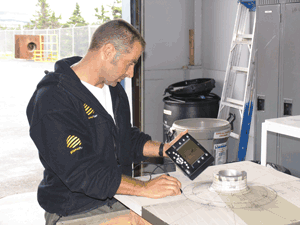
Trace NDE ltd offers a wide range of NDT training and certification programmes, to meet that of both international a nd national standards, commonly ASNT & PCN certification schemes, through accredited establishments, Trace NDE Ltd is currently awaiting PCN accreditation.
- Magnetic Particle Inspection
- Liquid Penetrant Inspection
- Eddy Current Inspection
- Ultrasonic Inspection
- Radiographic Inspection
- Radiographic Interpretation
Magnetic Particle Inspection
 |
Magnetic particle inspection (MPI) is a Non Destructive NDT Technique that is used for the detection of surface and near-surface flaws in ferromagnetic materials. A magnetic field is applied to the surface of the specimen, either locally or overall, using either a permanent magnet, an electromagnet, flexible cables or hand-held prods. If the material is in good condition and defect free, the majority of the magnetic field is concentrated below the material's surface. However, if a flaw is present, such that it interacts with the magnetic field, the flux is distorted locally and 'leaks' from the surface of the specimen in the region of the flaw. Fine Metallic Particles, applied in solution to the surface of the specimen, are attracted to the area of ‘flux leakage’, and a visible indication is detected. The materials commonly used for this purpose are black iron particles and red or even yellow iron oxides. In some cases, the iron particles are coated with a fluorescent material which enables them to be viewed under a Ultraviolet Lamp in a darkened area. |
Liquid Penetrant Inspection
Dye Penetrant (DPI) is a Non Destructive NDT Technique of detecting the presence of surface cracks and imperfections through use of a special dye.
The basis of Liquid penetrant is the capilliary effect of a liquid to penetrate into surface breaking defects. The area for inspection is coated in the dye and left to soak, usually for approximately 20 minutes, followig that the excess penetrant is then removed and the surface cleaned. Once any excess penetrant is removed, the dye that has entered into a defects begins to bleed back out and can be observed with the use of a background developer. In some cases, the dyes are coated with a fluorescent material which enables them to be viewed under a Ultraviolet Lamp in a darkened area. /p>
Eddy Current Inspection
 |
Eddy Current Inspection is a Non Destructive NDT Technique that is used for the detection of surface and near-surface flaws in conductive materials. The basis of Eddy Current Inspection: To undertake Eddy Current Inspection a circular coil carrying an AC current is held adjacent to an electrically conductive specimen. The alternating current in the coil generates a magnetic field, which interacts with the test object and induces ‘eddy currents’ within the test pieces, They get their name from “eddies” that are formed when a liquid or gas flows in a circular path around obstacles when conditions are right. These eddy currents in return send returning eddy currents back to the receiving probe. Fluctuation in this returning ‘signal’ are monitored and measured, Variations in the electrical conductivity or magnetic permeability of the test object, or the presence of any flaws, will cause a change in eddy current flow and a corresponding change in the phase and amplitude of the measured current. This is the basis of standard (flat coil) eddy current inspection, the most widely used eddy current technique. |
Ultrasonic Inspection
Ultrasonic Inspection is a Non destructive Inspection technique that utilises sound waves to undertake an inspection on a component, much in the same way as ultrasound is used in hospitals for scans on unborn babies.
High frequency sound is transmitted into the test material and the time taken for the returning echo is diaplayed on a screen and interpretated by the inspector. A means of locating defects in steel. When acoustic energy in the ultrasonic range is passed through steel, the sound waves tend to travel in straight lines. If there is a defect in the path of the beam it will cause a reflection of some energy depleting the energy transmitted. The resulting acoustic shadow can allow for the detection of these defects.
Radiographic Inspection & Interpretation
... to be updated soon.
Home ¦
Copyright
¦ Privacy Policy
¦ Terms of site use
¦ Email
login
© 2006 - 2008 Trace NDE Ltd - All rights reserved.
Site created and maintained by Derek Liversidge.